fertility

Environment / 5 weeks ago
Countries with the highest testosterone levels
A new visual by World Visualized highlights the countries with the highest average testosterone levels, measured in nanograms per deciliter (ng/dl). The data reveals some surprising global trends, with Uzbekistan leading the world at 773 ng/dl, followed closely by Croatia (752 ng/dl) and Cameroon (731 ng/dl).
Environment / 6 weeks ago
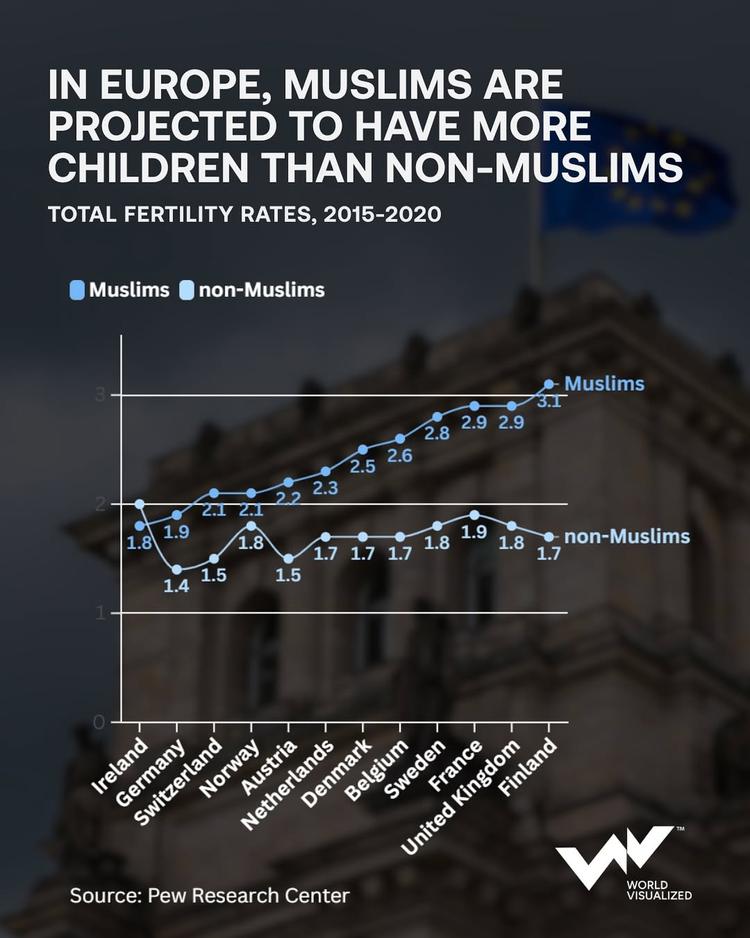
Muslims in Europe are having more children than non-Muslims
Across Europe, birth rates tell a changing story. According to new findings from the Pew Research Center, Muslim families are having more children on average than non-Muslims, a pattern that is reshaping the region’s population dynamics. From 2015 to 2020, Muslim women in countries like Finland recorded an average of 3.1 children per woman, compared to 1.7 among non-Muslims.
World / 6 weeks ago
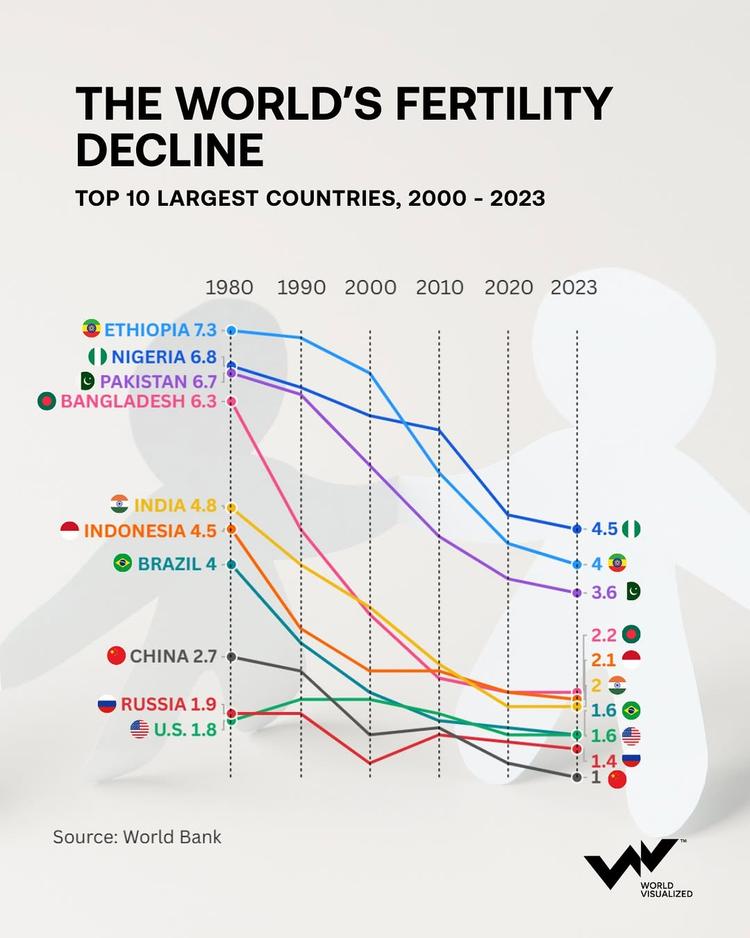
5 of the world’s 10 largest countries now below replacement-level fertility
Across much of the world, people are having fewer children than ever before. A new visual from World Visualised, using World Bank data, shows a striking pattern: between 2000 and 2023, fertility rates in the ten largest countries have fallen sharply, and in five of them, they’ve dropped below the replacement level of 2.1 births per woman. According to the data, this includes China, Russia, the United States, Brazil, and Indonesia, nations that together make up nearly half of the world’s population. Meanwhile, countries like Nigeria, Ethiopia, Pakistan, Bangladesh, and India have also seen steady declines, though their rates remain above replacement for now.

Maps / 16 weeks ago
The world’s 10 most populous countries in 2025
The global population reached 8.23 billion people in 2025, according to estimates compiled by Database.Earth, a data portal that draws on the United Nations figures. The milestone coincided with a historic demographic shift of India surpassing China to become the world’s most populous country, illustrating how fertility trends and migration are reshaping the planet.

Maps / 25 weeks ago
How populations of Greece and Turkey have evolved between 1927 and 2020
Between 1927 and 2020, Greece and Turkey experienced markedly different population trends, reflecting their unique historical, political, and socio-economic developments. In 1927, Turkey's population stood at approximately 13.6 million. Over the subsequent decades, the country witnessed significant growth, reaching 83.6 million by 2020. This expansion was particularly rapid in the post-World War II era, with annual growth rates peaking at nearly 3% in the early 1960s.

Environment / 26 weeks ago
South Korea’s fertility crisis deepens as national average falls to 0.72
South Korea’s fertility rate has continued its record-breaking decline. It reached an unprecedented national average of just 0.72 children per woman in 2023, according to new data from Statistics Korea (KOSTAT). A closer look at the regional fertility map, compiled by The World in Maps from KOSTAT data, reveals significant disparities across the country:

Maps / 29 weeks ago
Where youth rules: The countries with the youngest populations in 2025
According to recent United Nations data, a powerful demographic trend is emerging across several African nations: the youth population is dominating. Leading the list is Niger, where a remarkable 56.9% of the population is under 18, followed by Uganda at 55% and Chad at 54.6%.

Maps / 37 weeks ago

